
How to Bring Your Dog to the Office Without Regretting It
A dog who lies quietly under your desk while you take calls, greets your coworkers without launching at their coffee, and handles the printer noise without flinching is an office asset. Getting there takes specific preparation that most people skip.
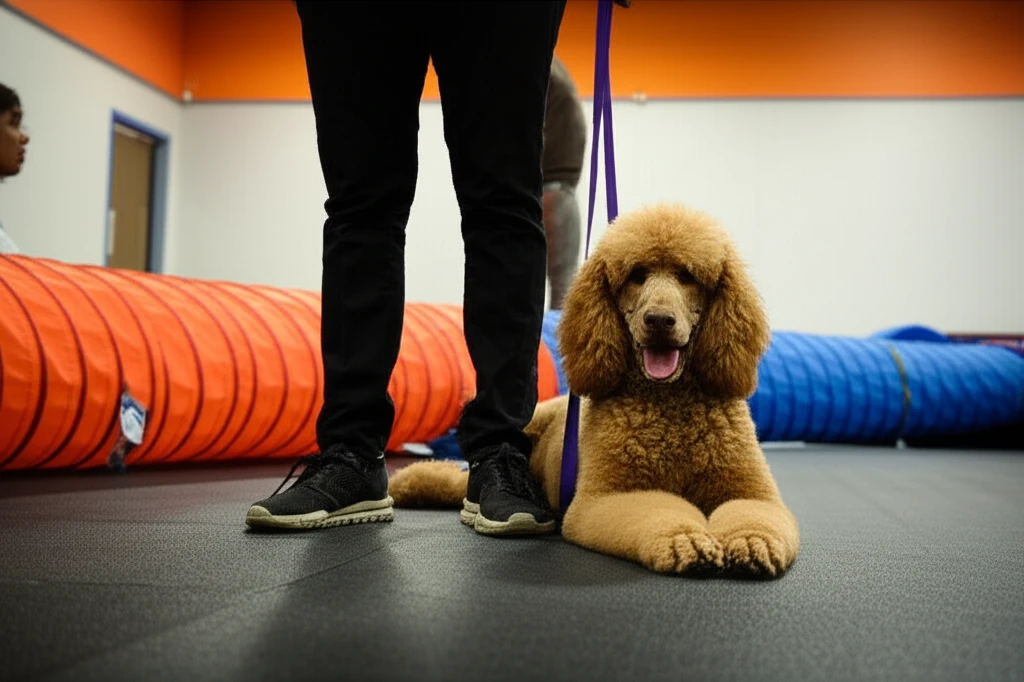
The Settle Cue Is the Whole Game
Office life for a dog is essentially a multi-hour settle. Your dog needs to lie on a bed or mat near your desk, stay there while people walk past, remain calm during phone calls and conversations, and do this for stretches of two to three hours between breaks. That is a high-level skill, and it is the single most important behavior to have dialed in before bring-your-dog-to-work day.
Start training the settle at home during your actual work hours. Put a mat next to your desk, cue your dog onto it, and reward calm behavior with quiet praise or a small treat every few minutes. Gradually stretch the intervals between rewards. Your dog should learn that settling on the mat is a low-effort way to earn good things. Over a few weeks, you can fade the treats almost entirely because the behavior itself becomes a comfortable default. This is the same positive reinforcement approach that builds every other reliable behavior.
If your dog cannot hold a settle for 30 minutes at home with no distractions, they are not ready for an office environment. That is not a judgment. It is a training benchmark you can work toward.
Greeting Coworkers Without the Full-Body Tackle
The second most common office dog problem, after restlessness, is inappropriate greetings. Your coworkers will want to say hello to your dog. Your dog will want to say hello to your coworkers. If your dog's version of hello involves jumping up, pawing, or mobbing anyone who approaches your desk, that goodwill evaporates fast. One jumped coffee is all it takes.
Train an alternative greeting behavior: four feet on the floor, or better yet, a sit. When someone approaches, cue the sit and let them greet your dog only when your dog is in position. If your dog breaks the sit and jumps, the person turns away. The greeting is contingent on the behavior you want. This takes repetitions with patient helpers before it works under the excitement of a real office environment.
Also accept that not all of your coworkers want to interact with your dog, and some may be uncomfortable around dogs entirely. Keep your dog at your workspace. Do not let them roam hallways, visit other desks uninvited, or approach people in the break room. Your dog's access to the office exists because it does not create problems for anyone else.
Office Sounds, Smells, and Surprises
Offices are full of sudden noises: printers, ringing phones, slamming doors, dropped binders, and the general hum of humans working in close proximity. A dog who startles at unexpected sounds or responds to the office doorbell with a round of barking is going to disrupt everyone around you.
Sound sensitivity is a socialization issue. Dogs who have been exposed to a variety of environmental sounds during their developmental period and beyond handle office noise as background rather than as something that demands a response. If your dog is reactive to specific sounds, work on desensitization at home before adding the complexity of an office. Play recordings of office sounds at low volume during calm activities, gradually increasing volume as your dog shows indifference.
Smells are an underrated challenge. Offices have lunch rooms, snack drawers, food deliveries, and coworkers eating at their desks. A dog who scavenges or who gets up and investigates every food smell needs more impulse control work before the office is appropriate. The same food-refusal skills that make restaurant dining possible apply here: your dog learns that ignoring food they were not given is what produces rewards.
The First Day: Set It Up to Succeed
Do not make the first day a full eight-hour test. Bring your dog in for two to three hours during a quiet period, ideally when fewer coworkers are around. Arrive with your dog already exercised, so they are ready to settle rather than wired. Set up their mat, a water bowl, and a long-lasting chew at your workspace before you bring them in.
Keep the first visit boring on purpose. Do your normal work. Let your dog practice settling in the real environment with real sounds and smells. If they do well for two hours, that is a success. Take them home before they get restless or overstimulated. Build up the duration gradually over several visits, just like you would build up any other socialization exposure.
Have an exit plan. If your dog starts barking, pacing, or cannot settle, calmly pack up and leave without drama. This is information, not failure. It tells you exactly what needs more work before the next attempt. Maybe they need a longer settle at home, or more exposure to novel environments, or more practice around groups of unfamiliar people.
Not Every Dog Is an Office Dog, and That Is Fine
Bringing your dog to work is an advanced lifestyle goal, not a starting point. It requires a dog who has a solid settle, polite greetings, sound tolerance, food-refusal skills, and the ability to stay calm in a stimulating environment for hours. Some dogs are temperamentally suited for this and some are not, regardless of training. A high-drive herding breed who needs significant daily exercise may struggle with the enforced stillness of office life. A dog with separation anxiety might actually do better at the office than home alone, but only if their anxiety does not manifest as attention-seeking behavior that disrupts your work.
Be honest about where your dog is right now. If they can handle new environments calmly and hold a long settle, the office is a realistic next step. If they are still working on basic obedience and environmental confidence, invest in that foundation first. The office will still be there when your dog is ready. Find a Zoom Room near you to build the settle and socialization skills that make bringing your dog to work a genuine pleasure instead of a liability.
Frequently Asked Questions
How do I convince my employer to allow dogs in the office?
Start with a written proposal that addresses the common objections: allergies, fear of dogs, liability, and cleanliness. Suggest a trial period with clear ground rules, such as dogs must be leashed or tethered at the handler's workspace, dogs must be current on vaccinations, and any dog that is disruptive gets removed immediately. Offer to keep your dog in a crate or on a mat at your desk rather than roaming freely. Having a Canine Good Citizen certification adds credibility to your proposal because it demonstrates that your dog has been evaluated on basic public behavior. Reference research on workplace dogs reducing stress, but lead with the practical logistics.
What do I do if my dog barks at coworkers walking past my desk?
Barking at passersby usually means your dog is either startled, overstimulated, or resource-guarding your space. Address it by first positioning your dog's mat where they are not directly facing the main traffic path. Practice at home with family members walking past while your dog is on their mat, rewarding quiet behavior with treats. In the office, redirect your dog's attention to a chew or treat before the barking starts, not after. If the barking persists despite practice, your dog may need more environmental socialization before the office is the right setting for them.
How long can my dog stay at the office without a break?
Plan for a break every two to three hours. Your dog needs to go outside to relieve themselves, stretch, sniff, and decompress from the indoor environment. These breaks should be genuine outings, not a 30-second trip to the nearest patch of grass. A 10 to 15 minute walk gives your dog physical exercise and mental reset before returning to the settle. Puppies and young dogs need more frequent breaks. If your schedule does not allow for regular breaks, consider bringing your dog for a half day rather than pushing through a full one.
Ready to Bring Your Dog to the Office?
Zoom Room's obedience and socialization classes build the extended settle, greeting manners, and environmental confidence your dog needs to thrive in a workplace. You train alongside your dog in a controlled indoor gym.
Find a Zoom Room