
Puppy Biting and Nipping: Why It Happens and How to Handle It
Your puppy bites your hands, your ankles, your sleeves, your hair, and your patience. Those tiny teeth are razor-sharp, and they never seem to stop. Here is the truth that most puppy owners need to hear: this is completely normal, it is not aggression, and you cannot fully solve it alone in your living room.
Why Puppies Bite Everything (Including You)
Puppies explore the world with their mouths the same way human babies explore with their hands. They do not have fingers, so they use teeth. Everything gets mouthed: your skin, your furniture, other dogs, shoelaces, chair legs, and anything else within reach. This is not a behavior problem. It is normal developmental behavior, and every puppy does it.
Mouthing and biting serve several functions during puppyhood. Between three and six months, puppies are teething. Their baby teeth are falling out and adult teeth are coming in, and their gums are sore, itchy, and uncomfortable. Chewing and biting provide relief. Outside of teething, puppies bite during play because that is how dogs play with each other: mouth wrestling, jaw sparring, and chase-and-grab are normal parts of canine social play. They also bite to get attention, to initiate interaction, and because the movement of your hands and feet is genuinely exciting to a young dog with developing prey instincts.
The reason those puppy teeth are so sharp is actually part of the learning process. Puppy teeth are needles because puppies have weak jaw muscles. The sharpness compensates for the lack of force, but it also means that even gentle mouthing hurts, which triggers a reaction from the recipient. That reaction, a yelp from a littermate, a withdrawal from a playmate, is the feedback mechanism that teaches puppies to control the force of their bite. This process is called bite inhibition, and it is one of the most important lessons your puppy needs to learn.
Bite Inhibition: The Skill You Cannot Teach Alone
Bite inhibition is a dog's learned ability to control the pressure of their mouth. A dog with good bite inhibition can take a treat gently from your fingers, carry a toy without destroying it, and mouth during play without causing injury. A dog with poor bite inhibition applies full force in every interaction, which is manageable in a ten-pound puppy but dangerous in a seventy-pound adult.
Here is the part that surprises most new puppy owners: bite inhibition is primarily learned through social play with other puppies, not through human training. When two puppies play and one bites too hard, the other yelps and stops playing. The biter learns that too much pressure ends the fun. They adjust. They try again with less force. Through hundreds of these micro-interactions, puppies calibrate their jaw pressure to a level that keeps the game going. This is peer-to-peer learning that happens in real time, at dog speed, with dog-appropriate feedback.
You can contribute to this process at home by withdrawing attention when your puppy bites too hard (more on technique below), but you cannot replicate the speed, consistency, and quantity of feedback that other puppies provide. A puppy in a play group gets dozens of bite-pressure corrections in a single session. At home, you might manage a handful per day, and your timing and consistency will never match what another puppy delivers instinctively.
This is why puppy socialization classes that include off-leash play with other puppies are not optional enrichment. They are essential for bite inhibition development. The critical window for this learning is between three and sixteen weeks, with continued practice through about six months. Puppies who miss this window often grow into adults with harder mouths, not because they are mean, but because they never got the feedback they needed to learn the skill. Zoom Room's puppy socialization classes are specifically designed to provide this kind of structured, supervised play in a safe indoor environment.
Redirection: What to Do When Your Puppy Bites You
While socialization handles the big-picture bite inhibition work, you still need a strategy for the dozens of times per day your puppy sinks their teeth into your skin. The approach is straightforward, but it requires patience and consistency from everyone in the household.
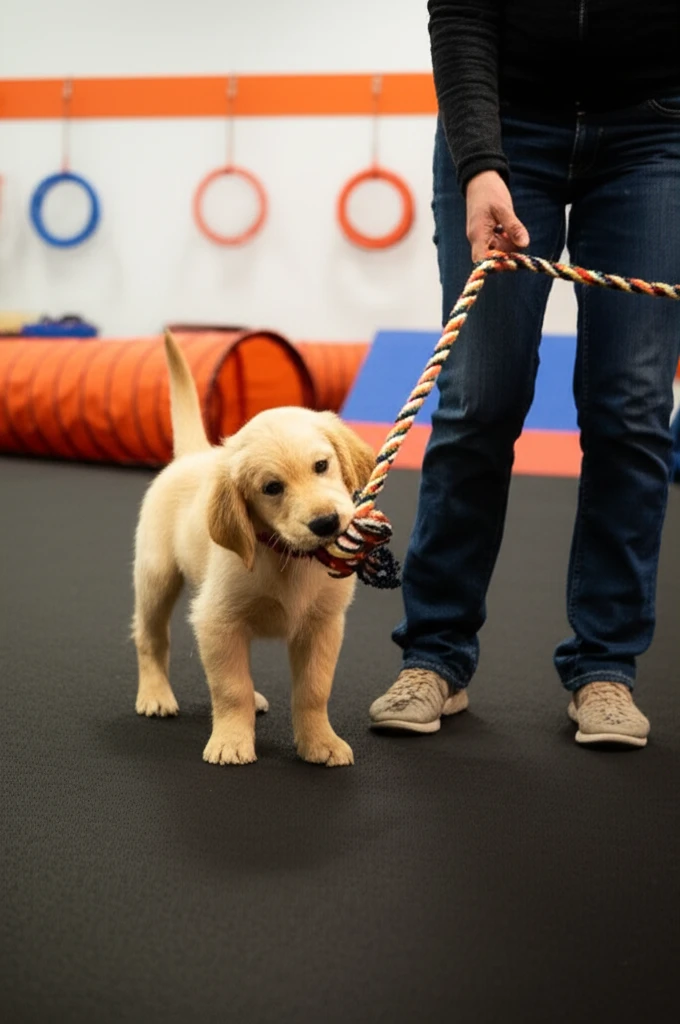
Step one: redirect to a toy. When your puppy starts mouthing your hand, immediately offer a toy. Not as a bribe after they have been biting for thirty seconds, but as a preemptive swap the instant their mouth moves toward your skin. Keep toys accessible in every room. Rope toys, rubber toys, and stuffed toys all work. The goal is to teach your puppy that hands are not chew toys, but this thing is. Many puppies will happily redirect if the toy is presented early enough in the sequence.
Step two: withdraw attention for hard bites. If your puppy bites hard enough to hurt, say "ouch" in a calm, neutral tone (not a shriek, which can escalate excitement), and immediately stop all interaction. Stand up, turn away, and remove your attention for ten to fifteen seconds. Then re-engage. If the puppy bites hard again, repeat. If three withdrawals in a row do not reduce the intensity, the puppy is probably overstimulated and needs a break, not more practice. Calmly place them in their settle spot or crate with a chew toy for a few minutes to decompress.
Step three: manage the environment. Puppy biting gets worse when the puppy is overtired, overstimulated, or has too much unstructured freedom. If your puppy turns into a tiny alligator every evening at seven, they are probably overtired and need an enforced nap, not more play. If they bite harder during rough play, lower the intensity of your play style. If they target ankles during movement, keep a toy in your hand to redirect before the lunge happens. Anticipate the pattern and set up the environment so your puppy is more likely to make good choices.
What not to do: do not hold your puppy's mouth shut, do not flick their nose, do not spray them with water, and do not pin them down. These responses are punitive, they damage trust, and they teach your puppy that human hands near their face are something to be wary of. That is the opposite of what you want for a dog who will need to accept handling at the vet, the groomer, and throughout daily life.
The Teething Timeline: When It Gets Better
Puppy biting follows a predictable developmental timeline, and knowing where you are on it helps you calibrate your expectations.
Eight to twelve weeks: Your puppy arrives home with a full set of 28 razor-sharp baby teeth. Mouthing is constant and exploratory. The puppy is learning what everything in their new world feels like, tastes like, and how it responds to being bitten. This is the highest-volume biting period, but the force is usually low because jaw muscles are still developing.
Twelve to sixteen weeks: Baby teeth start loosening and adult teeth begin erupting. Gum discomfort increases and so does the intensity of chewing and biting. Provide cold chew toys, frozen washcloths, and rubber teething toys to soothe the gums. This is also the peak socialization window, making it the ideal time for puppy play classes where bite inhibition learning is most effective.
Four to six months: The full set of 42 adult teeth comes in. This is often the most painful teething phase and the period where puppies chew the hardest. The good news: adult teeth are less sharp than baby teeth, so while the chewing is more intense, the mouthing may actually feel less painful on your skin. Continue redirecting to appropriate chew items and providing frozen enrichment for gum relief.
Six to eight months: Most puppies have their full adult dentition and the worst of teething is over. Mouthing during play may continue as a social behavior, but the frantic, constant biting of the earlier months subsides noticeably. If you have been consistently redirecting, withdrawing for hard bites, and providing socialization with other puppies, you should see a clear decrease in both frequency and intensity by this age.
If your puppy is past eight months and the biting has not decreased, or if the biting seems to come with stiff body language, hard staring, or guarding behavior rather than loose, wiggly play, consult a professional. That pattern may indicate resource guarding, fear, or frustration that needs a different intervention than standard puppy mouthing.
When Mouthing Crosses a Line
Normal puppy biting is loose, wiggly, and happens in the context of play or exploration. The puppy's body is relaxed, their tail is wagging or neutral, and the biting reduces when you redirect or withdraw. This is the behavior described above, and it resolves with time, consistency, and socialization.
There are situations where the biting looks different, and those warrant a closer look. A puppy who bites with a stiff body, direct stare, or growl when you approach their food, take away a toy, or try to move them off furniture is not playing. That is early resource guarding, and while it is manageable, it requires a specific desensitization approach rather than the standard redirection protocol.
A puppy who bites harder when restrained, during grooming, or when being picked up may be communicating fear or discomfort. These puppies need systematic handling desensitization, where you pair gentle touching and restraint with high-value treats, building a positive association with being handled. Forcing through the resistance teaches the puppy that biting is the only way to make uncomfortable things stop.
A puppy who has had no socialization with other puppies by twelve weeks is at higher risk of developing poor bite inhibition and rough play skills that persist into adulthood. If you adopt an older puppy or rescue a dog who missed the socialization window, marker-based training can help you shape gentler mouth behavior, but the process is slower than what peer-to-peer play accomplishes during the critical period.
For any biting situation that feels out of the normal range, early intervention is key. The earlier you address it, the easier it is to modify. At Zoom Room, our trainers evaluate puppy biting in context and help you determine whether you are looking at normal mouthing that needs patience, or a behavioral pattern that needs a targeted plan. Find a Zoom Room near you to get professional guidance during the puppy stage when it matters most.
Frequently Asked Questions
Should I yelp loudly when my puppy bites to mimic what another puppy would do?
This is widely recommended but does not work for every puppy. Some puppies respond to a yelp by pausing, which gives you a moment to redirect. But many puppies get more excited by the high-pitched sound and bite harder, interpreting your yelp as an invitation to escalate the game. If your puppy escalates when you yelp, skip it. A calm, neutral "ouch" followed by an immediate withdrawal of attention is more effective for these puppies. The key is that the biting causes the fun to stop, not that you produce a specific sound. Experiment with what works for your individual puppy and stick with the approach that reduces the biting.
Is my puppy being aggressive if they growl while biting during play?
Almost certainly not. Growling during play is normal puppy behavior. Play growls are typically lower-pitched, accompanied by a loose, wiggly body, and happen in the middle of bouncy, exaggerated play movements like play bows, zoomies, and pouncing. Aggressive behavior looks different: the body is stiff, the mouth is tight, the eyes are hard, and the growl is paired with freezing or snapping rather than bouncing. If your puppy growls while play-biting with a loose, relaxed body, they are playing. If the body goes stiff and the growling is directed at you when you approach their food or possessions, consult a trainer.
My puppy only bites certain family members. Why?
Puppies often target the people who give them the biggest reaction or who engage in the most exciting play. Children are common targets because they move fast, make high-pitched sounds, and often pull their hands away quickly, all of which trigger a puppy's chase and grab instincts. If your puppy targets kids more than adults, it is not personal. Teach children to stand still and be boring when the puppy mouths, rather than running or screaming. Supervise all puppy-child interactions, and give the puppy frequent nap breaks since overtired puppies bite more. Adults who play rough with the puppy may also get more mouthing because the puppy has learned that those people are the ones who engage in physical play.
Ready to Raise a Gentle-Mouthed Dog?
Zoom Room's puppy socialization classes give your puppy the off-leash play time they need to develop bite inhibition with other puppies, in a safe indoor gym with professional supervision. You learn alongside your puppy with real-time coaching.
Find a Zoom Room