
Resource Guarding in Dogs: What It Really Means and What to Do
Your dog stiffens over their food bowl, growls when you reach for a chew toy, or blocks you from sitting on the couch. It feels personal, but it is not. Resource guarding is one of the most normal behaviors in the canine world, and understanding why it happens is the first step toward making it better.
Resource Guarding Is Not a Character Flaw
Resource guarding is a dog's way of protecting something they value. It exists because it works, evolutionarily speaking. For thousands of years, a dog who held onto food, sleeping spots, and mates was more likely to survive than one who gave everything up without hesitation. Your dog did not learn this from being spoiled or from a lack of discipline. It is hardwired, and it shows up across every breed, age, and background.
Guarding can look different depending on the dog and the resource. With food, you might see a freeze over the bowl, hard eyes, a low growl, or eating faster when someone approaches. With toys or chews, the dog might carry the item to a corner, turn away from you, or snarl if you reach for it. Some dogs guard spaces: a specific bed, a spot on the couch, a crate. Others guard people, positioning themselves between their favorite person and other dogs or family members. All of these are on the same spectrum. The dog is communicating, clearly, that they are not comfortable sharing in that moment.
The critical thing to understand is that the growl, the freeze, and the hard stare are warning signals, not attacks. They are your dog asking for space. If you punish those warnings, you do not eliminate the guarding. You eliminate the warning, which means the next escalation may come without any signal at all. That is how bites happen. Respect the communication, and then work on changing the underlying emotion.
Why Some Dogs Guard More Than Others
Any dog can resource guard, but some are more prone to it than others. Dogs who experienced scarcity early in life, whether in a hoarding situation, a shelter with communal feeding, or as strays competing for scraps, often guard more intensely because they have a real learning history that says resources disappear. Puppies who were part of large litters where competition at the food bowl was fierce sometimes carry that guarding behavior into their new homes.
Genetics play a role too. Some breeds and breed lines are predisposed toward more intense resource holding, not because of any "dominance" trait, but simply because selection pressures varied. This is not a moral judgment. A dog who guards food is not a bad dog any more than a herding dog who nips heels is a bad dog. Both are expressing normal behavioral tendencies that need management in a human household.
Stress and anxiety amplify guarding. A dog who is generally anxious, whether from fear-based behavior, insufficient socialization, or environmental stressors, is more likely to guard because their overall sense of safety is already compromised. Addressing the broader anxiety often reduces guarding intensity as a side effect.
Guarding can also develop or escalate in multi-dog households, especially when a new dog is introduced and access to valued resources suddenly feels competitive. If you are seeing guarding behavior emerge after adding a second dog, that is a predictable response to a change in resource availability, not a sign that the dogs cannot coexist.
Management: Setting Everyone Up for Safety
Before you start any desensitization work, you need a management plan. Management means arranging the environment so the guarding behavior does not get practiced while you work on changing your dog's emotional response. Every time your dog rehearses guarding successfully, meaning they guard and the perceived threat goes away, the behavior gets stronger.
For food guarding, that might mean feeding your dog in a separate room behind a closed door or baby gate. Let them eat in peace. Do not stand over the bowl, do not reach into it, and do not take it away to "teach them you are in charge." That approach, once common advice, is outdated and counterproductive. All it teaches the dog is that people near the bowl mean the food disappears, which makes guarding worse. If you have multiple dogs, feed them in separate spaces with a barrier between them.
For toy or chew guarding, avoid taking high-value items away by force. Instead, trade. Offer something of equal or higher value (a piece of chicken, a different chew) so your dog learns that giving something up leads to something better arriving. If a particular item triggers intense guarding, remove it from the rotation entirely for now. There is no reason to keep testing a scenario you know will escalate.
For space guarding, use physical management. If your dog guards the couch, block access to it temporarily with furniture or a leash station, and provide an equally comfortable alternative like a dog bed. If the dog guards their crate, do not reach into it while they are inside. These are not permanent changes. They are safety measures that protect everyone while you do the actual behavior modification work.
Desensitization: Changing How Your Dog Feels About Approach
The goal of desensitization is not to teach your dog to tolerate you taking things. It is to change their emotional response so that a person approaching their resource predicts something good, not a loss. This is counter-conditioning, and it works because you are operating at the level of emotion, not obedience.
Start with food bowl exercises. While your dog is eating their regular meal, walk past the bowl at a distance where they notice you but do not stiffen. As you pass, toss a high-value treat (something better than kibble, like a piece of chicken or cheese) so it lands near the bowl. You are not reaching in. You are adding something good from a safe distance. Repeat this over multiple meals, gradually decreasing the distance as your dog begins to look up with a relaxed body when they hear you coming, because your approach now predicts a bonus.
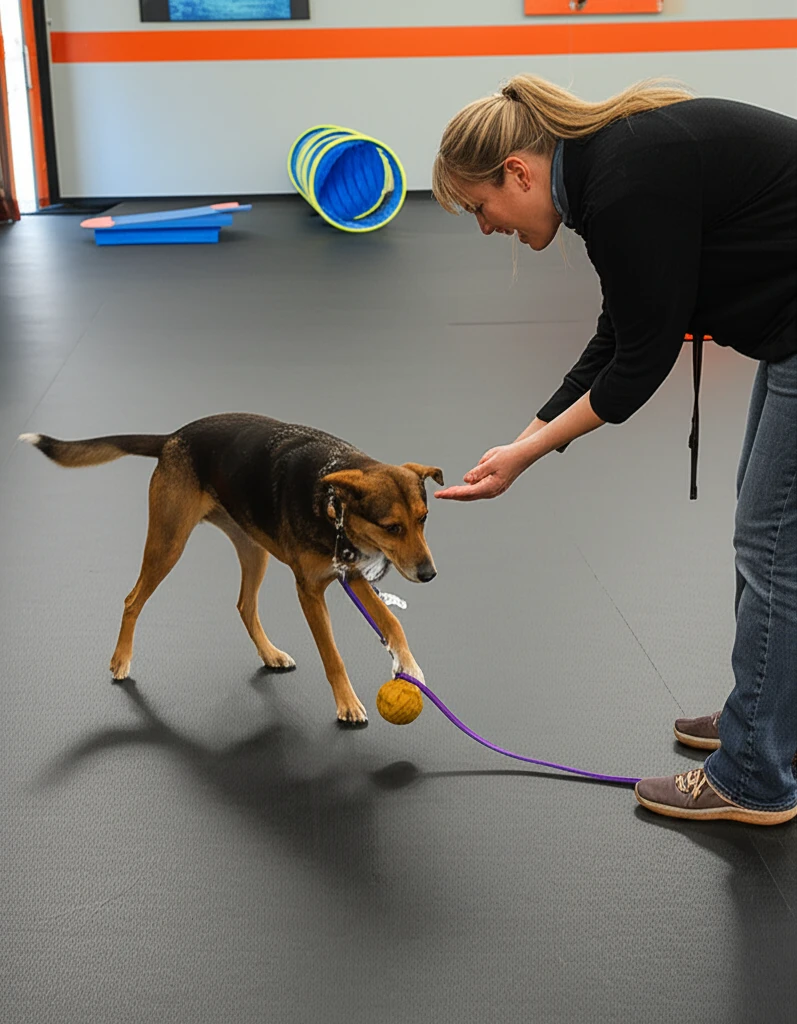
The trade-up game is the core skill for toy and chew guarding. Present a treat near your dog's nose while they have the item. When they drop the item to take the treat, praise calmly, let them eat, and then give the item back. Read that last part again: give the item back. The entire point is teaching your dog that letting go of something does not mean losing it forever. Once your dog is eagerly dropping items in exchange for treats, you can add a cue like "drop it" or "trade." But the cue comes after the behavior is reliable, not before.
For dogs who guard from other dogs specifically, work with a professional. Dog-to-dog guarding involves reading two sets of body language simultaneously and managing spatial dynamics that are difficult to handle alone. A structured group class with professional oversight can help both dogs learn to coexist around resources in a controlled environment.
When to Get Professional Help
Mild guarding, a freeze or a look when you approach the food bowl, is something most owners can address with consistent management and the desensitization exercises above. But there is a point where professional help is not optional.
Seek a certified trainer or veterinary behaviorist if your dog has snapped or bitten over a resource, if the guarding is escalating in intensity or expanding to new items, if you have children in the home and any level of guarding is present, or if you feel unsafe approaching your dog in any context. These are not failures. They are signals that the behavior has reached a level of intensity that requires a professional eye, a structured behavior modification plan, and possibly a veterinary evaluation to rule out pain or other medical contributors.
Avoid any trainer who recommends confrontational approaches: taking the bowl away to "establish rank," alpha rolling the dog, or using corrections to suppress the growl. These methods are based on debunked dominance theory and they make guarding more dangerous, not less. Look for someone who uses positive reinforcement and has specific experience with resource guarding cases.
At Zoom Room, our trainers see guarding behavior regularly and can help you build a plan that addresses your specific situation. Because you train alongside your dog in our indoor gym, you learn to read the early signals, practice the trade-up exercises with coaching, and build the mechanical skills you need to do this work safely at home. Find a Zoom Room near you to get started.
Frequently Asked Questions
Should I take my dog's food bowl away while they are eating to prevent resource guarding?
No. Taking your dog's food bowl away during meals is one of the most common recommendations that actually makes guarding worse. From your dog's perspective, people approaching the bowl means the food disappears, which gives them more reason to guard. Instead, make your approach predict something good by tossing a high-value treat near the bowl as you walk past. Over time, your dog learns that a person near their food means a bonus is coming, not a loss. This changes the emotional response at the root of the behavior.
Is resource guarding a sign of dominance?
No. Dominance theory as applied to pet dogs has been debunked by the very researcher whose wolf studies originally inspired it. Resource guarding is a normal survival behavior, not a power play. Your dog is not trying to control you or establish rank. They are protecting something they value because their brain is wired to do that. Framing it as dominance leads to confrontational responses that damage trust and make the behavior more dangerous. Address guarding through management and desensitization, not by trying to outrank your dog.
My dog only guards from other dogs, not from people. Is that still a problem?
Dog-to-dog resource guarding is common and worth addressing, especially in a multi-dog household. It can escalate if unmanaged, particularly during high-value situations like mealtimes, treat distribution, or access to a favorite resting spot. Start with management: feed dogs separately, distribute chews in different rooms, and ensure each dog has their own bed or crate. Then work with a trainer who can help you practice structured exercises where both dogs learn that resources are abundant and the other dog's presence predicts good things rather than competition.
Ready to Address Resource Guarding Safely?
Zoom Room's trainers help you understand your dog's guarding behavior and build a plan using positive desensitization and trade-up games. You train alongside your dog in a controlled indoor gym with professional coaching.
Find a Zoom Room