
Puzzle Toys for Dogs: Ditch the Bowl and Make Every Meal Count
Your dog eats two meals a day and finishes each one in under 60 seconds. That is roughly two minutes of engagement from the single most motivating resource in your dog's life. You are leaving an enormous amount of enrichment value on the table, or rather, in the bowl.
Why the Food Bowl Is Failing Your Dog
In the wild, canids spend a significant portion of their waking hours engaged in food-related activities: tracking, hunting, scavenging, caching, and problem-solving their way to every calorie. The domestic dog's brain is still wired for this level of food-related engagement. What we give them instead is a stainless steel bowl filled twice a day, requiring zero effort, zero problem-solving, and zero time. The meal is gone before the dopamine system even knows it happened.
This matters because food-seeking is one of the primary ways dogs are built to use their brains. When you eliminate the challenge from eating, you remove a major source of mental stimulation from your dog's daily life. That unspent cognitive energy has to go somewhere, and it often shows up as the behaviors people find most frustrating: destructive chewing, demand barking, restlessness, counter surfing, and garbage raiding. Your dog is not misbehaving. They are bored, and their most powerful motivator is being wasted in 60-second dumps.
The fix is simple and does not cost more time or money than you are already spending. Take the food out of the bowl and put it into something that makes your dog think. This single change, applied consistently, can reduce behavior problems, improve mealtime satisfaction, slow down fast eaters, and provide daily mental enrichment with zero additional effort once you have the right tools in place.
Types of Puzzle Toys and Food Enrichment
Food enrichment tools fall into several categories, and using a mix of them keeps meals novel and engaging.
Stuffable toys. The classic Kong is the most well-known, but there are dozens of variations: Toppls, Quests, and other hollow rubber toys that you pack with food and your dog works to extract. The simplest version is smearing peanut butter or wet food on the inside. For a longer challenge, layer kibble with wet food, banana, and yogurt, then freeze the whole thing overnight. A frozen stuffed Kong can occupy a dog for 20 to 40 minutes depending on the filling and your dog's experience level. This is the single most effective tool for pre-departure routines because it gives your dog a high-value activity to focus on when you leave.
Rolling and dispensing toys. Kibble-dispensing balls and bottles release food as your dog pushes them around the floor. These are great for dogs who eat too fast because they physically cannot inhale the food. They also provide light physical activity alongside the mental challenge. Start with a dispenser that has a large opening so food falls out easily, then adjust to smaller openings as your dog figures out the mechanism.
Snuffle mats. A snuffle mat is a mat made of fabric strips that you scatter food into, forcing your dog to use their nose to find and extract each piece. Snuffle mats engage the olfactory system the same way scent work does, and they produce the same calming effect: extended sniffing activates the parasympathetic nervous system and lowers arousal. They are excellent for dogs who need to decompress after a walk or before a stressful event.
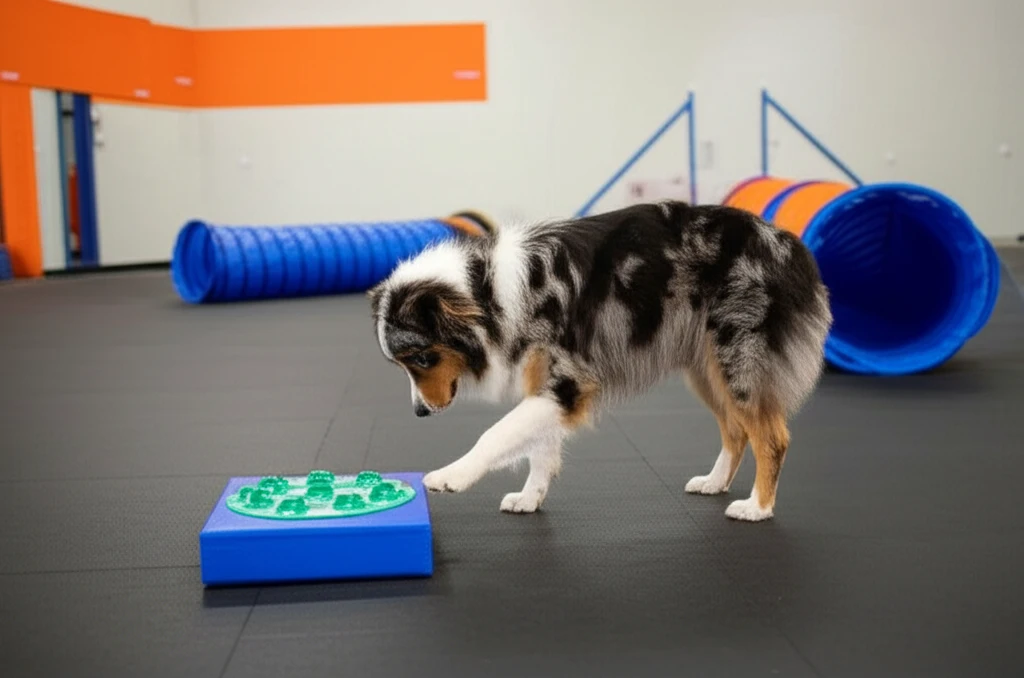
Flat puzzle feeders. These are rigid boards or trays with sliding panels, lift-up covers, and rotating compartments that your dog manipulates to access hidden food. Brands like Nina Ottosson and Outward Hound make puzzles at multiple difficulty levels. Start at the easiest level and only progress when your dog solves the current puzzle without frustration. The goal is engagement, not defeat.
Lick mats. A textured silicone mat spread with a thin layer of wet food, yogurt, pumpkin, or mashed banana. Licking is a self-soothing behavior for dogs, so lick mats are particularly useful for calming anxious or overstimulated dogs. Freeze the mat for a longer-lasting activity. Lick mats are low-effort enrichment that you can prepare in 30 seconds and they provide five to fifteen minutes of focused, calming engagement.
Matching Difficulty to Your Dog
The most common mistake with puzzle toys is starting too hard. An inexperienced dog confronted with a complex multi-step puzzle will try for a minute, fail, and walk away. That is not enrichment. That is frustration. And a frustrated dog may decide the puzzle itself is the chew toy, which is how you end up with plastic shards on your kitchen floor.
Start easy and build up. For a dog who has never used a food puzzle, the first experience should be almost free: kibble scattered on the floor, a Kong with food smeared on the outside (not stuffed inside), or a rolling dispenser with the largest opening. The goal is to teach your dog that interacting with the puzzle produces food. Once they understand the game, you can increase the challenge incrementally.
A good progression for stuffable toys: peanut butter smeared on the inside (easy) to loose kibble inside (moderate) to layered filling with wet food (harder) to fully frozen with packed filling (hardest). For flat puzzle feeders: start with all compartments open so food is visible, then close one, then two, until all compartments require manipulation. For snuffle mats: start by placing food on top of the fabric strips so it is visible, then push it deeper into the mat as your dog gets better at searching.
Impulse control naturally develops through this progression. A dog who starts by frantically pawing at a puzzle learns over time that a methodical approach works better. You will see your dog's problem-solving strategy evolve from brute force to thoughtful investigation as they gain experience. This cognitive growth is one of the most rewarding things to watch, and it transfers to other areas of their life: a dog who has learned to solve problems calmly at mealtime is a dog who approaches challenges more thoughtfully in general.
DIY Food Enrichment on a Budget
You do not need to spend a fortune on commercial puzzle toys. Some of the best food enrichment tools are things you already have or can make for free.
Muffin tin puzzle. Place kibble in the cups of a muffin tin and cover each cup with a tennis ball. Your dog must remove each ball to access the food. This is a perfect beginner puzzle that costs nothing if you already have the materials.
Cardboard box search. Fill a cardboard box with crumpled paper, paper towel tubes, and small boxes. Scatter kibble throughout. Your dog digs and forages through the material to find the food. This is messy (you will pick up shredded paper afterward) but it provides excellent sensory enrichment and mimics natural foraging behavior. Use boxes from your recycling bin and replace them when they are destroyed.
Towel roll-up. Lay a towel flat, scatter kibble across it, and roll it up. Your dog unrolls the towel with their nose and paws to get the food. Increase difficulty by folding the towel in half before rolling, or tying the rolled towel in a loose knot.
Scatter feeding. The simplest food enrichment of all. Toss your dog's kibble across the lawn, the kitchen floor, or a sniff-friendly area and let them forage. This turns a 60-second meal into a 10-minute nose work session with zero equipment and zero cost. It works on any surface, in any space, and with any dog.
Frozen treats. Fill an ice cube tray with low-sodium broth, drop a piece of kibble or a small treat in each cube, and freeze. These can be given as individual enrichment pieces or dropped into a water bowl for a fishing game on hot days. For a larger version, freeze broth and treats in a bundt pan or silicone mold for a longer-lasting activity.
The key with DIY enrichment is supervision. Cardboard, paper, and fabric can be ingested if your dog is a destroyer rather than a forager. Watch your dog during DIY activities and remove materials if they start eating the puzzle instead of foraging through it.
Building a Daily Food Enrichment Routine
The goal is not to add a complicated new activity to your day. The goal is to redirect the food your dog is already eating into a format that provides mental stimulation. Here is what a simple daily enrichment feeding routine looks like.
Breakfast: Stuff a Kong or Toppl with your dog's regular kibble, add a thin layer of wet food or yogurt, and freeze it the night before. Hand it to your dog in the morning. Prep time: two minutes the night before. Enrichment time for your dog: 15 to 30 minutes.
Midday (if applicable): Scatter a small portion of your dog's daily kibble allowance in the yard or on a snuffle mat. Prep time: 30 seconds. Enrichment time: 5 to 10 minutes.
Dinner: Use a flat puzzle feeder or a kibble-dispensing ball. Rotate the tool every few days to keep it novel. Prep time: one minute. Enrichment time: 10 to 20 minutes.
That is 30 to 60 minutes of mental engagement per day using food your dog was going to eat anyway, with a total prep investment of about five minutes. Compare that to pouring kibble into a bowl twice a day and getting two minutes of engagement. The cost is the same. The benefit is incomparably greater.
Rotate your enrichment tools on a weekly cycle to prevent habituation. A puzzle your dog has not seen in a week feels fresh again. Most households need three to five puzzle toys in rotation to keep things interesting. Start with one and add to the collection over time. The investment in puzzle toys pays for itself in reduced behavior problems, calmer evenings, and a dog who looks forward to meals as an activity, not just a transaction.
Enrichment extends well beyond mealtimes, and Zoom Room's classes provide the structured mental stimulation that complements what you do at home. Explore Zoom Room's enrichment-focused training programs and find a Zoom Room near you to start building a richer life for your dog.
Frequently Asked Questions
My dog gives up on puzzle toys after a minute. What should I do?
The puzzle is too hard. A dog who gives up quickly has not been set up for success. Go back to the easiest version of the puzzle and make sure food is almost free at first. For a stuffable toy, smear food on the outside so your dog gets an instant reward. For a flat puzzle, leave all the compartments open so food is visible. For a snuffle mat, place food on top of the fabric rather than pushing it deep inside. Once your dog understands that interacting with the puzzle produces food, they will invest more effort. Build difficulty in tiny increments and only increase when your dog is solving the current level confidently and eagerly.
Are puzzle toys safe to leave with my dog unsupervised?
It depends on the toy and your dog. Durable rubber toys like Kongs, Toppls, and West Paw products are generally safe for unsupervised use because they are designed to withstand heavy chewing without breaking into pieces. Flat plastic puzzle feeders, snuffle mats, and DIY cardboard enrichment should only be used under supervision because aggressive chewers can bite off and swallow pieces. Know your dog's chewing style before leaving them alone with any enrichment tool. If your dog has a history of destroying hard rubber toys or ingesting non-food items, supervise all puzzle toy use and choose the most durable options available.
Can I feed all of my dog's meals through puzzle toys instead of a bowl?
Yes, and many enrichment-focused owners do exactly this. There is no nutritional or behavioral downside to eliminating the food bowl entirely. Your dog's daily calorie intake stays the same; only the delivery method changes. Scatter feeding, stuffable toys, puzzle feeders, and training treats can account for 100 percent of your dog's daily food if you divide it appropriately. Some dogs with specific medical conditions that require precise meal monitoring may benefit from having at least one measured meal in a controlled format, so check with your veterinarian if your dog is on a prescription diet or has eating-related health concerns.
Ready to Upgrade Your Dog's Mealtime?
Zoom Room's enrichment-focused classes teach you how to channel your dog's food motivation into training, mental stimulation, and better behavior. Your dog works their brain while you learn the techniques that make everyday life richer.
Find a Zoom Room