
Loose Leash Walking: How to Teach Your Dog to Stop Pulling
If your daily walk feels more like a sled-dog competition than a stroll, you are not alone. Pulling on the leash is the single most common complaint among dog owners, and it is also one of the most misunderstood. Your dog is not trying to dominate you. They are just moving toward things they find interesting, and you happen to be attached.
Why Dogs Pull on the Leash
Dogs pull because it works. Every time your dog lunges toward a fire hydrant, another dog, or a discarded french fry and gets to reach it, they have learned that pulling produces access to the thing they want. That is a reinforcement cycle, and it is powerful because it is rewarded by the environment itself, not just by you. Even if you resist, even if the walk is a constant tug of war, the dog is still moving forward, and forward motion toward interesting things is inherently reinforcing.
There is also a simple physics issue. Dogs walk faster than humans. Their natural walking pace is a trot, and most humans amble. On a six-foot leash, a dog moving at their preferred speed will hit the end of the leash within seconds. They are not pulling to be difficult. They are pulling because the leash is the only thing preventing them from moving the way their body wants to move.
Understanding this matters because it shifts the training question from "how do I stop my dog from doing something wrong" to "how do I teach my dog that staying near me is more rewarding than pulling ahead." That reframe changes everything about your approach.
Loose Leash Walking vs. Heel: Know the Difference
Heel is a formal obedience position where your dog walks at your left side with their shoulder aligned to your leg, maintaining that position regardless of distractions. It is precise, it requires sustained focus, and it is mentally taxing for the dog. Expecting your dog to heel for an entire 30-minute neighborhood walk is like asking a person to walk in a straight line staring at the wall for half an hour. It is unreasonable for everyday life.
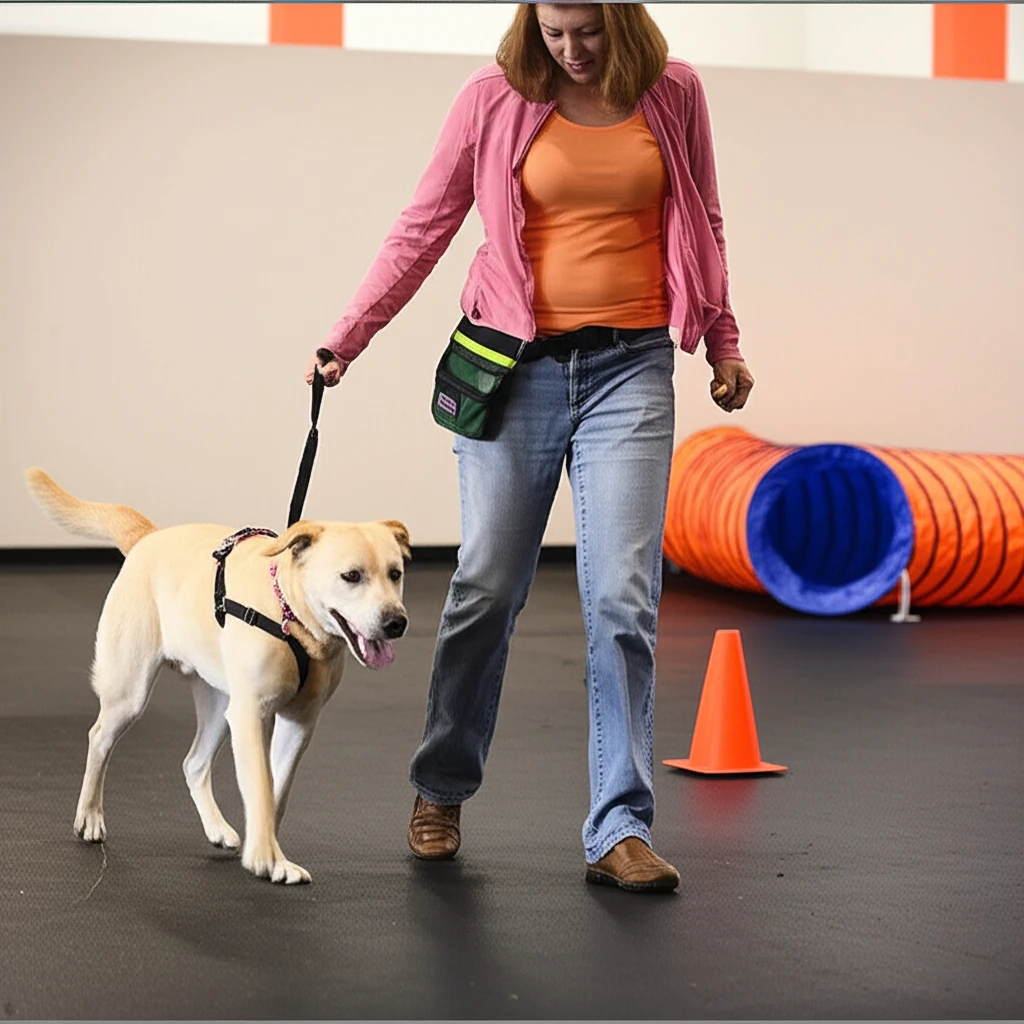
Loose leash walking is different. The criteria is simply that the leash has slack in it. Your dog can walk in front of you, beside you, or slightly behind you. They can sniff, look around, and explore. The only rule is that the leash stays loose, meaning no tension, no pulling. This is a much more realistic standard for daily walks, and it is achievable for every dog when taught correctly.
You can teach both skills, and they serve different purposes. Heel is useful for short stretches: crossing a busy street, walking through a crowd, passing a reactive dog at close range. Loose leash walking is the default for everything else. Knowing when to ask for which behavior is part of what makes walks pleasant for both of you.
The Training Mechanics That Actually Work
Loose leash walking comes down to three techniques used together. None of them are complicated, but all of them require consistency.
The reward zone. Decide where you want your dog relative to your body: at your side, slightly ahead, it does not matter as long as the leash is loose. Every time your dog is in that zone, mark it (with a clicker, a verbal marker like "yes") and deliver a treat at your side. At first you will be marking and treating constantly, every few steps. That is normal. You are building a habit of position. Over time, you space the rewards out as your dog starts to choose the reward zone on their own. Practice in a low-distraction environment first, like your living room or driveway, before taking it to the sidewalk.
Stop and wait. When your dog hits the end of the leash and creates tension, stop walking. Do not yank them back. Do not say anything. Just stop and become a tree. Wait for your dog to turn back toward you, take a step in your direction, or create slack in the leash. The instant the leash goes loose, mark and move forward. Your dog learns that pulling makes the walk stop and a loose leash makes the walk continue. This is the hardest technique for owners because it requires patience. Some walks, early in the process, will cover two blocks in thirty minutes. That is the investment that pays off later.
Direction changes. When your dog is locked onto something ahead and pulling, turn and walk the other direction without warning. Do not jerk the leash. Just smoothly change direction. Your dog will have to turn to follow you, which resets their focus. When they catch up and the leash is loose, mark and reward. Unpredictable direction changes teach your dog to pay attention to where you are going instead of assuming every walk is a straight line to the park.
Combine these three techniques on every walk. Over several weeks of consistent practice, your dog will internalize that walking near you with a loose leash is the fastest way to keep moving and earn rewards. Recall training builds on this same principle of making proximity to you more rewarding than distance.
Equipment: What Helps and What Does Not
A front-clip harness is the most useful tool for dogs who pull. Unlike a collar, which puts all the pressure on your dog's neck, a front-clip harness redirects pulling by turning your dog's body toward you when they forge ahead. It does not teach loose leash walking by itself, but it makes the training process safer and more manageable while you build the skill. Look for a harness with a front attachment point on the chest and a comfortable fit that does not restrict shoulder movement.
A flat collar and a standard six-foot leash work well for dogs who are already making progress. Avoid retractable leashes entirely. They teach your dog that pulling produces more leash length, which is the exact opposite of what you want. They also offer no control in an emergency and the thin cord can cause rope burns or serious injuries.
Do not use prong collars, choke chains, or shock collars. These tools suppress pulling through pain and discomfort, which means your dog is not learning to want to walk near you. They are learning to avoid the correction. That distinction matters. Pain-based tools can also create negative associations with the things your dog sees while wearing them, which is how a dog develops leash reactivity toward other dogs or people. The short-term suppression is not worth the long-term behavioral fallout.
A treat pouch worn at your hip keeps rewards accessible and your hands free. Use small, soft, high-value treats that your dog can eat quickly without stopping to chew. The faster the reward delivery, the cleaner the connection between the behavior and the payoff.
Taking It to the Real World
The biggest challenge with loose leash walking is generalization. Your dog may walk beautifully in your neighborhood but turn into a freight train at the park or on a new route. This is normal. Every new environment resets the difficulty level because there are new smells, new sights, and new things worth pulling toward.
When you move to a more distracting environment, increase your reinforcement rate. Go back to treating every few steps. Lower your expectations for distance and duration. Treat the new environment the way you treated your driveway in the first week. As your dog adjusts, you can thin the rewards again. This is not starting over. It is helping your dog apply a skill they already have to a new context.
Sniffing is not misbehavior. Dogs experience the world through their noses, and a walk that does not allow any sniffing is not enriching for them. Build sniff breaks into your walk. Let your dog sniff freely for 30 seconds, then use your cue to move on. You can even use "go sniff" as a reward for walking on a loose leash, since access to smells is often more valuable to your dog than a treat.
The payoff for all this work is significant. A dog who walks calmly on a loose leash is a dog you actually want to take places. Running errands together, exploring new neighborhoods, walking through outdoor markets: all of it becomes enjoyable instead of exhausting. Loose leash walking is also a prerequisite for more advanced real-world skills, because a dog who cannot walk calmly is not ready for the higher-distraction scenarios that come with a fully socialized life.
If you are struggling to make progress on your own, Zoom Room's obedience classes teach loose leash walking as a core skill. You practice in an indoor gym where distractions are controlled and a trainer can give you real-time feedback on your timing, leash mechanics, and reward delivery. Find a Zoom Room near you to get started.
Frequently Asked Questions
How long does it take to teach a dog to walk on a loose leash?
Most dogs show noticeable improvement within two to three weeks of consistent daily practice, but building a reliable loose leash walk in a variety of environments typically takes one to three months. The timeline depends on your dog's age, how long they have been practicing pulling, and how consistent you are with the training mechanics. A puppy who has never been reinforced for pulling will learn faster than an adult dog who has spent years being dragged to every fire hydrant. The key is consistency on every single walk, not just the ones where you feel like training.
My dog only pulls toward other dogs. What should I do?
A dog who pulls specifically toward other dogs is often frustrated by the leash, especially if they are social and want to greet every dog they see. This is different from a dog who pulls toward everything. Create distance when you see another dog and use high-value treats to reward your dog for looking at the other dog and then choosing to look back at you. This is a foundation exercise for leash reactivity work and it teaches your dog that other dogs predict good things from you, not a chance to lunge and greet. If the pulling is accompanied by barking, lunging, or stiff body language, that may be leash reactivity and should be addressed specifically.
Should I use a harness or a collar for loose leash walking?
A front-clip harness is the best option while you are actively teaching loose leash walking. It reduces pulling force, protects your dog's neck from collar pressure, and gently redirects your dog toward you when they forge ahead. Once your dog has a reliable loose leash walk, you can transition to a flat collar if you prefer. Avoid head halters unless recommended and fitted by a professional, as improper use can cause neck strain. Never use prong collars, choke chains, or shock collars. These suppress pulling through pain rather than teaching your dog to choose a loose leash.
Ready to Enjoy Your Walks Again?
Zoom Room's obedience classes teach loose leash walking as a core skill. You practice alongside your dog in a controlled indoor gym with a trainer who can coach your timing and mechanics in real time.
Find a Zoom Room